
Between Trees and Wind: The Alchemical Force of Change
The job of the artist is always to deepen the mystery.” — Francis Bacon
The Alchemist does not arrive announced. It arrives through a door left open by curiosity.
By the time I made the first images of Spectral Spring, I had been studying Photoshop seriously — not as a tool for correction, but as a space for intervention. Learning an instrument means discovering what it can do that you had not imagined. Some of those discoveries open doors. I walked through them.
Spectral Spring: Looking Up
I was in Venice for a personal artistic retreat — a week alone in a small rented house in the Castello district, moving through palaces and museums, thinking, working, looking. On my way back one afternoon, I passed through the Giardini della Biennale.
I looked up.
Between the trees, in the spaces between the leaves, there was light. The same instinct that had led me to photograph shadows and voids and margins — the same training that had produced 820 — stopped me. I had learned to see the space between things rather than the things themselves. Here, the space between the leaves was full of something I wanted to understand.
I started photographing.
Back in the studio, I began shifting the chromatic balance of those images — isolating specific spectral frequencies, pushing the color registers far beyond what the eye had seen. What emerged was unexpected. The trees had disappeared. What remained was something else: a memory of light held within the canopy, glowing against a void. The foliage had become a spectral apparition.
I was not manipulating the image. I was revealing what was already in it.

Don't look up without a camera.
This was the moment I understood the difference between the Oracle and the Alchemist. The Oracle witnesses what light carries. The Alchemist forces the light to show what it has metabolized — the invisible frequencies, the absorbed memories, the information that ordinary perception discards. Reality is not a fixed state. Changing the light changes the ontology of the object.
Bora: The Invention of the Wind
Bora comes later, and arrives differently.
By the time I made this series, the framework was closer — I was thinking more deliberately about what I was doing and why. I was in Trieste on holiday, walking along the Molo Audace on a brilliant day: strong sun, warm light, no wind at all. I stopped in front of the Rosa dei Venti — the compass rose embedded in the pier — and began photographing it in close-up.
The paradox was immediate. Here was an instrument designed to measure something entirely absent. A wind rose in the absence of wind. I started playing with the images — stretching, blurring, pushing the chromatic data — and something strange emerged. The images had movement. The light, manipulated, was doing what the wind was not: it was blowing.
Bora is the liminal wind — the wind that exists only in the light that describes it. The Alchemist, here, is doing something more radical than in Spectral Spring: using light to evoke a sensory experience that light, by definition, cannot show. Photons forced to behave like gusts of air.
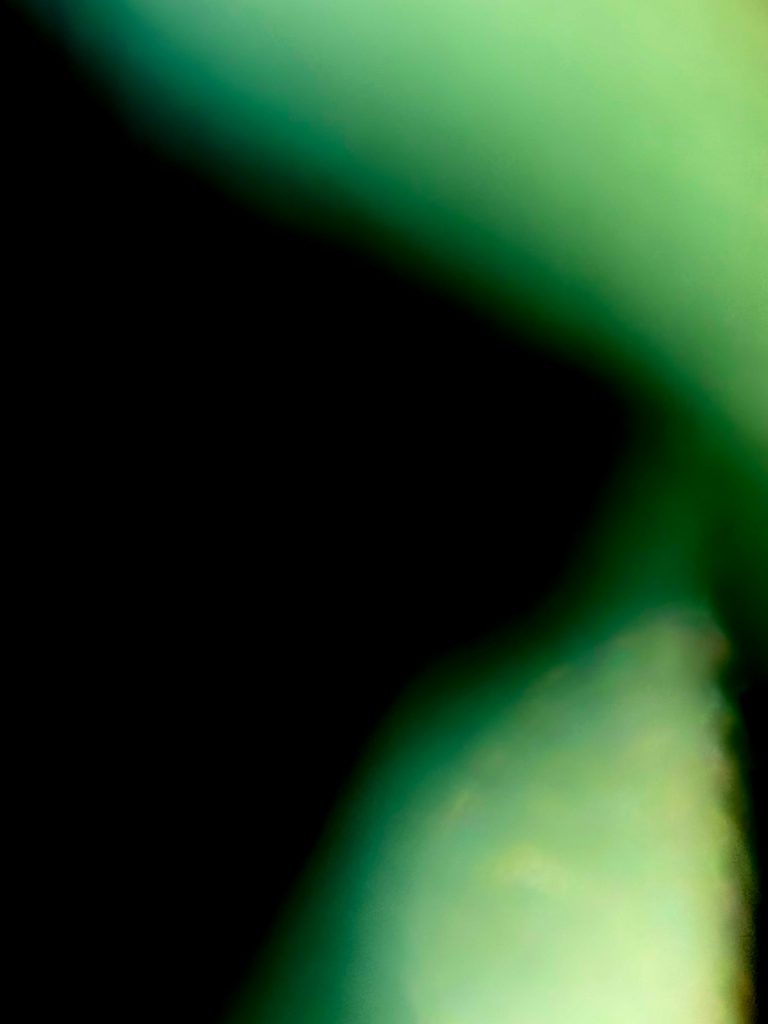
No wind was harmed in making this image.
The Alchemical Transition
These two series — one born from a glance upward in a Venetian garden, one from a paradox on a Trieste pier — trace the emergence of the Alchemist in my practice.
What connects them is the discovery that the signal can be forced to yield what ordinary perception misses. The Oracle taught me to intercept light before it fades. The Alchemist taught me that light contains more than it shows — and that the artist’s intervention can make that excess visible.
This was the necessary step before Genesi could be conceived. Before I could build a system that generates light from nothing, I had to learn that I had the power to change what light already carries. The Compass of Light did not yet have a name, but the Alchemist was already at work.


